maandag 21 september 2015

Brand identity and brand image

Problem: Brand identity and brand image


Learning objectives (LO):

1. How to build a strong brand identity?
  • What is the difference between brand identity and brand image?
  • How to manage brand identity?
  •  What are the most important elements of a brand?
2. How to follow your own image and how to keep it consistent?

3. Rebranding
  • Why do companies rebrand?
  • Case studies

Keywords: Brand identity, brand image, rebranding, storytelling, vision and mission

LO1: How to build a strong brand identity?

1.1 What is the difference between brand identity and brand image?

  •  Managementstudyguide
I found this table about brand identity and brand image here. The table looks at the different angles of identity and image, this makes the difference very clear. 

Brand image
- Current view of the customers about a brand: associations, set of beliefs about a brand, perception
- Emotional value, not just a mental image
- It should highlight an organization’s mission and vision to all. 
- Image is formed on basis of subjective perceptions that consumers have about the brand. Volvo = safety. Toyota = reliability.

- Image can be strengthened => brand communications: advertising, packaging, word of mouth publicity, other promotional tools, etc. => DIFFERENT from competitor's image 
- Brand image has not to be created, but is automatically formed. 

Brand identity
- Organization responsible for creating a product with unique characteristics. 
- Brand identity includes: Brand vision, brand culture, positioning, personality, relationships, and presentations.
- Mental and functional associations with the brand => familiarity and differentiation => trademark colours (for example - Blue colour with Pepsi), logo (for example - Nike), tagline (for example - Apple’s tagline is “Think different”),etc.
- Total proposal/promise that an organization makes to consumers. 
- Brand identity leads to brand loyalty, brand preference, high credibility, good prices and good financial returns.
Sources: 
- http://www.managementstudyguide.com/brand-identity.htm
- http://www.managementstudyguide.com/brand-image.htm

1.2 How to manage brand identity?
  • Taking brand initiative

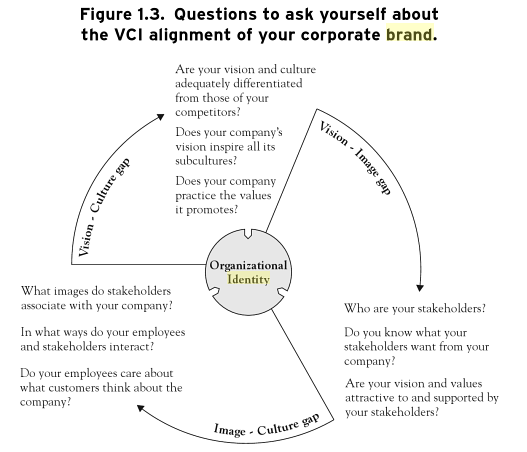
The greater the coherence between vision - culture and image (VCI) the stronger the brand:
- Vision: what company's top managers want to accomplish in the future
- Culture: what is believed of known by company employees
- Image: what external stakeholders expect/desire from the company


- Misalignments/gaps between vision, culture and image => bad (managed) brand => all the pieces have to be coherent, they have to form an integrated, expressive and satisfying whole that build strong corporate reputations.  


When managing a brand identity it can be very interesting to ask yourself the questions in the visual below. To keep the trust of your stakeholders you should manage your brand effectively. Not only during the brand launch but all the time, even when everything seems perfect. You should prevent gaps between vision, image and culture. When you have a gap your company seems less trustworthy. A brand identity manager should always pay attention to these questions and adapt the strategy if necessary.    


Source: Taking Brand Initiative  - Mary Jo Hatch,Majken Schultz p11-13https://books.google.fi/books?hl=nl&lr=&id=J5OiNWAREdAC&oi=fnd&pg=PR5&dq=manage+brand+identity&ots=0XqtdxZwwT&sig=pSu5HrPqfxX-DW_bTZGKFEXyrPk&redir_esc=y#v=onepage&q=manage%20brand%20identity&f=false


  • Brand identity manager - your brand's personal trainer
- Personal trainer gives you a comprehensive program, realistic goals, education => tailored to your needs to get the results you're looking for. A personal trainer is an experienced professional who can see exactly what approach will yield the best results => how to maximize your time to get the results you want and need.
- Brand identity manager => similar => professional to get the results you want and need out of your brand and business. =>  personal trainer for your brand.  Spot-On Branding can analyze your brand to see what shape it’s in, and then begin the process of getting that brand into great shape!
- Think of it like this: every facet of your brand is like a body part that needs attention and work.  This is the KEY to creating a strong brand identity for your business.  From your logo to your website design, from your marketing collateral pieces to your business cards, EVERY detail needs to be toned and strengthened regularly to create a strong and balanced brand.

A Brand Identity Manager:

  • Sees and creates the look and feel of your big brand vision, always aware, looking and moving toward the big picture results.
  • Is the center of your brand, working to conduct and orchestrate each and every component, so your brand is always working at peak performance.
  • Is thorough, with great attention to detail, so no bits of your brand are left behind or lacking.
  • Aligns all of your brand components to ensure each and every collateral/multi-media piece is branded consistently and effectively.
  • Develops a brand identity marketing strategy, outlining the best approach to snag your target market and popular demographics.
  • Finds the right vendors to work for you for total brand appeal, such as copywriters, printers, website developers, photographers, social media marketers, PR directors, and more!
  • Manages the aforementioned creative vendors for you, so you only have to deal with one person: your Brand Identity Manager, saving you time and money in the long run.
Source: http://ndrichardson.com/blog/2012/02/21/a-brand-identity-manager-your-brand’s-personal-trainer/

1.3 What are the most important elements of a brand?

1. The Brand Promise

- What will consumers get when they purchase a product or service? The brand promise incorporates more than just those tangible products and services. It also includes the feelings that consumers get when they use your products and services.
Ex: If you’re a Nike fan, the brand might represent athleticism, performance, strength, good health, and fun. 

2. The Brand Perceptions

- Brands are built by consumers, not companies, it’s the way consumers perceive a brand that defines it. It doesn’t matter what you think your brand promises. You need to work to develop consumer perceptions that accurately reflect your brand, or your brand is doomed to limited growth potential.
Ex: What are consumers’ perceptions of Lady Gaga? You can bet everything she does is meant to create specific consumer perceptions.

3. The Brand Expectations

- Based on your brand promise, consumers develop expectations for your brand. When they purchase your products or services, they assume their expectations for your brand will be met. If your brand doesn’t meet consumer expectations in every interaction, consumers will become confused by your brand and turn away from it in search of another brand that does meet their expectations in every interaction.
Ex: Imagine Rolls Royce launched a $10,000 car. To say the least, consumers would be extremely confused because such a product doesn’t meet their expectations for a luxury brand.

4. The Brand Persona

- “Who is a brand?” Every brand has a persona, your brand as a person. What is that person like? What can you expect when you interact with that person? From appearance to personality and everything in between, your brand persona is one that consumers will evaluate and judge before they do business with you.
Ex: Who would you rather spend time with: Apple or Microsoft? These two brands have very different brand personas. 

5. The Brand Elements

- Your brand is represented by the intangible elements described above as well as tangible elements such as logo, messaging, packaging, and so on. All of these elements must work together to consistently communicate your brand promise, shape brand perceptions, meet brand expectations, and define your brand persona. If one element is awry, your entire brand can suffer.
=> A brand is clear, reliable, and believable to both your consumers and your employees. 
=> Before you can define and live your brand, you need to do some research so you don’t waste time taking your brand in a direction that won’t allow you to reach your goals. 
=> You must understand your competitors and audience, so you can develop a brand that promises the right things to the right people. 
=> Research should be first, definition, strategy, and execution should follow, and in time, your brand will grow. 
Source: http://aytm.com/blog/branding/branding-factors

  • The business blueprint TV

Interesting video about the 4 most important elements of a brand, how you can start branding from the inside out instead of from the outside in.
- Clarity: mission, vision and values => project brand message clearly
- Audience, ideal client => who are you talking with
- Team needs to understand where you want to go 
- Client experience: online/offline/combination => what you're going to be known for 

LO2: How to follow your own image and how to keep it consistent?
  • How to keep your image consistent? 

- Building a strong brand = consistency => consistent brand gets noticed. This recognition brings prospective new business. It is vital to be consistent across all communication channels. But what are the best ways to do this?

1. Examine your brand
- Take a look at your brand over time => ensure it remains true to the business. Researching how your brand is perceived can highlight issues you never knew existed.
- Brand and marketing review => interviews with clients => give you a better understanding of customer interpretations and reactions to your marketing and brand. You can also do an internal review with employees to better understand their view of the company.
- Once you’re aware of any problems, you can act accordingly. 

2. Appearance
- It is important to get it right at the foundations of your brand so you have a strong platform from which to builD => appearance should achieve clarity and consistency across the foundations of your brand (fonts, logos, colour palettes, images and most importantly, the presentation of your service names and descriptions) Think of any strong brand and you are likely to be able to list its colours, use of imagery and the products it sells. This is what creates recognition, trust and therefore engagement. 
- No matter whether someone sees an email, advert, brochure or social media profile, or attends one of your sponsored events, they will recognise immediately it is you and that they can trust it.

3. Messaging  
- Audience should know what to expect from your brand. Regularly changing your media spokesperson or sending messages that don’t tie-in with what you stand for is likely to cause confusion.
- Having the same person quoted each time there is a mention in the press will show a human side to your brand and companies will be more likely to recognise you. 
- Brand message should achieve recognition, trust and engagement. If the audience recognises a piece of communication they are more likely to engage with it.That doesn’t mean every single thing has to look identical all of the time, but using a consistent tone of voice and look and feel will ensure your communications are instantly recognisable.
- Brand presence => more than a nice logo and a bit of advertising – it is the summation of everything you stand for, everything you believe in and everything you do. It is how you look, how you talk and how you act.
- Creating a good impression in the minds of your customers and prospects is vital in today’s market. It can help deliver a competitive advantage, a greater return on investment and long-term brand loyalty. It can help build a better business.
- A consistent brand creates trust. If prospects trust you they are much more likely to buy your services. If your customers trust you they are more likely to stay with you, but even more crucially, they are more likely to recommend you to others.

Source: http://www.b2bmarketing.net/knowledgebank/branding/best-practice/how-keep-your-brand-consistent


    LO3: Rebranding
    3.1 Why do companies rebrand?


    OUT WITH THE OLD, IN WITH THE NEW

    On average, organisations and brands change their corporate identities once every seven to ten years. This often involves restyling logos, colour palettes, visual language and the photographic style. In a small number of cases, the name of the organisation is also changed during this process. Although there is usually one main reason for making the change, the motivation behind a rebranding project is often a combination of several factors. Here is an overview of the ten most common reasons for a corporate rebranding.

    1. MERGERS, ACQUISITIONS AND DEMERGERS

    For the most part, changes of business ownership, such as mergers, acquisitions and demergers, result in an immediate rebranding. The aim here is not only to make the change visible, but also to comply with legal requirements. In the case of demergers, the party that has split off is obliged to develop its own brand. This makes clear that it no longer forms part of the organisation. Over the past few years this process has taken place at grid operators, which were obliged to split off from their energy company. This resulted in the companies Enexis, Alliander and Stedin. There are several possibilities when it comes to mergers and acquisitions. The new company may develop a completely new brand (as in the case of @home, Casema and Multikabel, which together became Ziggo). In other cases the name of one of the parties is used (e.g. Getronics, which continued under the KPN brand following its acquisition by KPN).

    2. REPOSITIONING

    If implemented properly, a change to the positioning and brand promise of a company has major consequences for the organisation. Everything is adapted in line with the organisation’s new strategy and promise: its products or services, HR policy, customer contact, corporate identity, etc. Rebranding makes this change visible for all stakeholders. We saw an example of this last year with Gamma, which repositioned itself by moving away from traditional home improvements (DIY) and towards interiors (enjoyment).

    3. INTERNATIONALISATION

    In some cases, rebranding is necessary so that a brand can also be used internationally. This may be because the brand name is too specific to a particular country (e.g.: NS Internationaal, which has become NS Hispeed). In certain countries a brand name may also conjure up the wrong associations. Organisations that sell the same products in several countries, but under different brand names, are also increasingly opting to use one brand internationally. Famous examples include the rebranding of Jif to Cif, Smiths to Lay’s, Raider to Twix and Postbank (which was only used in the Netherlands) to ING (the brand that is used everywhere internationally).

    4. CHANGING MARKETS

    For some companies, changes in the market situation mean that their very existence comes under threat. The digitisation of society in particular is making it necessary for certain sectors to reinvent themselves. Different requirements call for a different product to be offered. One example here is the Free Record Shop, which adapted its logo, corporate identity and retail environment in 2008 to give its brand a boost.

    5. BAD REPUTATION

    If a brand has a bad reputation and this is having a serious impact on its operating result, rebranding can ensure that negative associations with the brand are ameliorated or dispelled. It is important here that not only the exterior changes, but that the change is also implemented in all other aspects of the organisation. This is the only way that a rebranding project can remove any negative associations with the brand and therefore be successful. The rebranding of VendexKBB to Maxeda is one example of this.

    6. CONFLICT WITH STAKEHOLDERS

    Developing a brand may in itself also lead to a rebranding. This may be because the new style is too similar to an existing brand, for example. Such a situation was faced by Multimate, which, after its rebranding, lost a lawsuit against Ikea as the two brands had become too similar. Multimate had to make sure that its new logo was no longer visible in any shape or form within a period of six months. Another reason is that a rebranding can sometimes be so negatively received by internal and external stakeholders that it stands in the way of the organisation’s success. An example of this from last year was the rebranding of clothing company Gap, which decided within the space of a week that it would keep its old logo after all.

    7. NEW CEO

    A new CEO often brings a new lease of life to an organisation. This may result in (major) organisational changes that also influence the course the company takes. Such a situation arose at Apple, for example, following the return of Steve Jobs in 1997. At that time Apple had to change in order to survive. Jobs himself took a hand in choosing the new logo, which changed from the rainbow-coloured apple to the more modern metallic variant.

    8. OUTDATED IMAGE

    One of the most common reasons for undertaking a corporate rebranding project is modernisation. Trends mean that over time brands come across as old-fashioned if they have not been updated. Although in many cases it is not the main reason, a more modern image is often one of the motivations behind a rebranding project.

    9. CHANGING BRAND PORTFOLIO

    Over the years, an organisation has to deal with the development and acquisition of numerous new brands. In time this results in an extremely diverse and broad brand portfolio that is no longer logical for anyone and is therefore only still understood by a handful of people. Furthermore, carrying many different brands often leads to high costs when it comes to maintaining and promoting the brand. In such cases, rebranding ensures that the entire brand portfolio is brought into line and tells a clear story about the organisation. A number of years ago, USG People rationalised and coordinated its brand portfolio in this way.

    10. FURTHER DEVELOPMENT OF CORPORATE IDENTITY

    A few years ago, for the majority of organisations a corporate identity consisted of just a logo, a primary colour palette and typography. Brand elements such as a photographic style, visual language and a secondary colour palette had not been defined back then. This meant that there was a great deal of freedom when it came to applying the corporate identity, with the result that the brand’s visual image ultimately became something of a mess. In such cases the further development of an organisation's corporate identity is a must to ensure the creation of a consistent and recognisable brand.

    THE TOP FOUR REASONS FOR CHANGING A COMPANY NAME

    A few years ago, for the majority of organisations a corporate identity consisted of just a logo, a primary colour palette and typography. Brand elements such as a photographic style, visual language and a secondary colour palette had not been defined back then. This meant that there was a great deal of freedom when it came to applying the corporate identity, with the result that the brand’s visual image ultimately became something of a mess. In such cases the further development of an organisation's corporate identity is a must to ensure the creation of a consistent and recognisable brand.
    Source: http://www.vim-group.com/en/top-ten-reasons-rebranding/

    3.2 Case studies
    • 10 mistakes marketeers make when rebranding

    Interesting video about rebranding. 

    • 10 succesful rebranding campaigns

    Source: http://www.businessinsider.com/10-most-successful-rebranding-campaigns-2011-2?IR=T


    maandag 14 september 2015

    Integrated marketing communication

    Problem: How to keep messages about the brand consistent through different channels (and tools)? 

    Learning objectives (LO):
    1. How to coordinate IMC? Define IMC. What is the role of the different parties/participants in IMC (media-agencies, departments, ...) 
    2. How to choose the right tools and channels for IMC? How to implement them successfully? Case studies.
    3. How is the message affected by the channels and coordination? 

    Keywords:
    /

    LO1. Define IMC. What is the role of the different parties/participants in IMC (media-agencies, departments, ...), How to coordinate IMC? 

    1.1 Define IMC
    • Youtube video made by Tribus, a British content creation and marketing agency 
    Under this link you find an interesting introduction video about how a small company (with a small budget) can use IMC to grow their business. The video explains how IMC can influence the amount of customers.

    Source: https://www.youtube.com/watch?v=k6WF0O1Mnvk

    • 'Definition' American marketing association
    "A planning process designed to assure that all brand contacts received by a customer or prospect for a product, service, or organization are relevant to that person and consistent over time.”

    In my opinion this explains IMC in a very beautiful way:  The IMC planning process has been compared to composing a musical score. In a piece of music, while every instrument has a specific task, the goal is to have them come together in a way that produces beautiful music. It’s the same in IMC, where advertising might be your violin, social media your piano, public relations your trumpet and so on.

    Source: http://imc.wvu.edu/about/what_is_imc

    • Integrated marketing communication according to William Chitty
    Integrated marketing communication harmonizes the different elements of the marketing communication mix. All the elements of the communication mix (advertising, sales promotions, direct marketing, outdoor displays, sponsorships, ...) should work together. Only that way we can achieve the organization's marketing communication objectives and enhance the equity of the brands.

    Integrated marketing communications represents all the elements of the marketing mix that facilitate exchanges by targeting the brand to a group of customers, positioning the brand as being distinct from competitive brands and sharing the brands meaning and unique difference with the product's target audience. A company had to maintain a consistent message over time and across the different communication channels to achieve a competitive market share. Marketing and communication are inseperable. Marketing is communication and communication is marketing. All organizations B2B, B2C, non profit use marketing communication to promote their offers and achieve their marketing goals. For example Mc Donalds used several different kinds of marketing communications to launch a new burger: radio, outdoor, online, newspapers and magazines.

    Integrated marketing communication should develop and deliver messages about the benefits and the features of different types of products, services, stores, events and/or people. Most marketing communication occurs at brand level. With marketing communication a brand creates expectations about what it will deliver in term of consistent quality, convenience, reliability and status. Whit marketing communication you can show a strong, favorable brand, you can highlight features and benefits that consumers seek. 

    Source: Integrated Marketing Communications by  William Chitty,Nigel Barker,Bill Chitty,Michael Valos,Terence A. Shimp https://books.google.fi/books?hl=nl&lr=&id=VZQraFDCtIEC&oi=fnd&pg=PR5&dq=integrated+marketing+communication&ots=seyH9Ymy8W&sig=WVVSshw2IkidSKuYV3y9fw1ZXQo&redir_esc=y#v=onepage&q&f=false


    • Graph about Integrated marketing communications
    This picture shows that all the tools of integrated marketing communication are interaction with each other and that they all come together in the middle where someone coordinates them. This pictures gives an overview of all the tools a company can use in integrated marketing communication. IMC is all about consistence and synergy between the different marketing communication tools. Between the company and the brand; between price, place, promotion and product and between all the marketingcommunicationtools. 


    Source: http://agp-inc.com/integrated-capabilities/

    • Powerpoint Didier Van Gijseghem: Belgian docent communicatiemanagement


    IMC has to be 
    - distinctive: recognizable sender, no confusion with competitors
    - Consistent on multiple levels:  business-brand, proposition/brand promise, image, look and feel, several instruments and media
    - Synergy: the overall effect must be more than the sum of all the separate effects. Do not use all the possible instruments but use the instruments that match your brand in an optimal mix.
    - Last but not least. IMC has to have a goal. A positive, distinctive and consistent identity of an organization that is relevant to the target group(s) 

    In the powerpoint slides we see the earlier marketing communication and the marketing communication in IMC. Earlier we looked at the marketing communication target group and goals, than we made a creative concept for a tv or radio spot and all the other communication instruments were deviations of the tv-campagne. Nowadays we make a creative concept and we apply the concept to all the different communication instruments. Making a marketingcommunicationmix that supports the marketingcommunicationgoals is most important. 


    Source: Powerpoints IMC - Didier Van Gijseghem- Docent Communicatiemanagement (powerpoint based on: Floor, K. & Van Raaij, F. (2010), Marketingcommunicatiestrategie (6e herziene druk). Groningen: Noordhoff


    • Slideshare presentation

    I have took this slide out of a slideshare presentation of B2Bwhiteboard. The presentation is about IMC, what it is, when it's used, ... This slide is about communication in the old world (traditional communication) and communication in the new world (IMC). It's really interesting to have a look at the other slides in the presentation but this slide particularly draw my attention because it really explains the relevance of IMC in a constantly changing world. 


    Source: http://www.slideshare.net/nbairstow/the-role-of-integrated-marketing-communications

    1.2 What is the role of the different parties/participants in IMC (media-agencies, departments, ...) + How to coordinate IMC

    To understand the different roles of the different parties that are involved in IMC we have to take a look at the golden triangle. This triangle gives an overview of the three players in IMC:
    - The companies (manufacturer/service firms, retailers, suppliers, non profit, ...) who want to communicate with consumers about their brands
    - The agencies who help the company to prepare marketing communication messages and select appropriate media to communicate the message (full service agencies, MC suppliers, freelancers, ...)
    - The media who provide the channel of communication for the messages (content providers, national and local media)
    => these three parties can't operate without each other. Smaller companies can make the choice not to use agencies for their communication 


    • The company
    The 2 pictures show the difference between a traditional corporate organization and a project-based organization. In larger companies there is often have a separate department to handle marketing communication responsibilities (marketing services). A company that wants to use IMC has to integrate the whole company, and not only one department. All the communication disciplines can't be in one single department. Cross functional planning needs a project based organization. All the departments have to work together. The organization needs to bring various communication disciplines in a single body or unit. Only that way we can ensure consistency in all brand messages, make sure that the creative idea is clear in all messages. It is also easier to coordinate the timing and scheduling of the different IMC outcomes. So at first a company should change inside before it can be shown to the world. It's not always easy to change your company completely and communication disciplines as public relations and marketing communication can still be a little bit divided but when there is a communication between these two disciplines there is more support and it will be easier to work together. In a traditional corporate organization it is almost impossible to deliver a consistent messages about all the different products, about the whole company if every department operates on its own. A cross-functional team will have a long-term focus, they work over the departments so they know what happens in all the departments and that way they can deliver a consistent message. 

    • Agencies
    Agencies are very important in IMC. You can have services provided by a single agency or a company can use a network of interacting agencies. It is not that easy to make all the agencies work together. There are always questions like who will be the leader? 

    Most of the times the client (so the company) leads the implementation and development of IMC. This is easier than when it's done by an external agency because internal staff knows the company better than anyone else. But it is very important that not 1 person is responsible for IMC, it has to be integrated so the whole company should be involved. Most brands have several agencies with their own skills. This is useful because an agency can be used in one campaign but not in another, the can provide support when necessary. But for the client it's not so easy to manage the integrative approach. 
    - The company has a full-service bureau that does all the integrated communication. This is easy because you only have one contact person and there is less coordination than when you have more agencies. But is it really possible that one agency is good in everything, can they be the best in PR and Direct marketing at the same time?  
    - The company can appoint a lead agency that is responsible for the integration. This lead agency coordinates a PR-bureau, e-marketingbureau, ... This is a better option because you have more specialized agencies but it involves more coordination.   
    - Another way is to coordinate different specific agencies yourself. it's more difficult to manage but the outcome can be more creative. You only have to look that the whole creative idea is the same and clear for all the different agencies so that all the communication material matches with each other. It's also not easy to work with the different agencies that are often even competitors of each other.  

    • Media
    The media can't exist without the companies because they need the money of the advertisements to keep existing. The companies can't live without the media because they need it as a platform to show their information to the world. Media is very important because a company can really target certain constituencies by choosing a media channel that targets the same people. Mediabuying is a separate occupation. The most important thing to know is that buying time on tv, radio, paying a place for advertising in a magazine, ... is very expensive. It is impossible for a small company to be frequently on national TV. They better invest their money in very specific channels to reach their target groups. 


    Source: I found all this information in an interesting presentation on slideshare. I compared the information with a powerpoint from last year in Belgium. The course was all about integrated marketing communication and the information matched. Whenever I thought that it was necessary
    I have added some information from the course to the info in the powerpoint. I also added information from the book 

    Marketing Communications: Interactivity, Communities and Content. 

    - http://www.slideshare.net/Shelly38/3imc-partners-and-crossfunctional-organizationppt
    - Powerpoints IMC - Didier Van Gijseghem- Docent Communicatiemanagement (powerpoint based on: Floor, K. & Van Raaij, F. (2010), Marketingcommunicatiestrategie (6e herziene druk). Groningen: Noordhoff
    - https://books.google.fi/books?id=5sl0X4PU4moC&pg=PA263&lpg=PA263&dq=different+agencies+IMC&source=bl&ots=3Bvwje-FfW&sig=yk3vxynGPWfyUYtNmEDAils6fcc&hl=nl&sa=X&ved=0CD0Q6AEwBGoVChMI1q-bpZryxwIVY49yCh2PvAN5#v=onepage&q=different%20agencies%20IMC&f=false


    LO2. How to choose the right tools and channels for IMC? How to implement them successfully? Case studies.

    • Don't forget these points when you're making the marketingmix!


    There are different tools in marketing communication. Some tools reach a lot of people but they are less rich. A contact is more volatile on the internet compared to a personal approach. In B2B communication we tend to use more rich channels with less reach. Because if you want to make a business deal, you can invest more time and money in it. You will have a higher cost per contact but the impact will be bigger. When you are B2C reach is often more important than the richness of the contact. People cross so many advertisements that it's much more difficult to really stand out in the crowd. B2C will often give us more contacts with less impact. The graph above shows clearly which instruments are used to get more richness and which are used to get more reach. The scheme below shows the different communication instruments compared to the effectivity (to reach a goal) and the cost/contact. For example. An external seller is very convincing, it's someone who can convince the people to buy something because he can speak about his own experiences, personal contact is experienced as more reliable. But personal contact is expensive. It's very expensive an has a low reach because te seller can't speak to everyone. When we look at the internet, this had a low effectivity and a low cost/contact. Everyone is on the internet so the reach is very high but you have to be striking enough to get noticed.     

    The most important thing for IMC is that all the instrument you use in the mix are perfectly matched. You have to make a marketing communication plan that evaluates the strategic roles of media advertising, direct marketing, internet marketing, pr, ...=> these instruments need to be combined in a way so that we get maximum impact on our target group. 
    - The concept must be clear in all the instruments. This does not mean that every instrument needs to have the same visual, but the idea must be consistent through all instruments. 
    - The planning of the instruments is also very important. For example, when Lidl announces in a tv spot that they're going to have a tv for only 200 euros next week, when the time is there the communication in the store, online communication, maybe even the newsletter must be consistent and very well planned. 
    - Integration is very important. Posters can repeat a tv spot-message (simultaneous) but it can also be that there is a radio spot after a tv campaign. The radio spot can have a 0800 number and so the company can count how many calls they got and so they can see if the campaign was effective.


    • Different communication tools


    Advertising:
    + advertiser controls the message
    + high reach - low cost/reached person
    + effective way to create brand images and symbolic appeals
    - High cost for production and running ads
    - credibility? You're talking about your own company
    - Clutter
    - How effective was the campaign? No direct indication

    B2C => national and local advertising 
    B2B => professional and trade advertising

    Example B2B advertising


    Source: http://www.wrwunited.de/news_mail/wrwnews_0611_e_web.htm

    Direct marketing (direct mail, catalogs, telemarketing, direct response ads, direct selling, internet)
    + Nowadays people are more receptive to direct-marketing For example: I like the weekly mail with clothes especially chosen for me, based on my previous choices.  Direct marketing is more personal.  
    + Marketeers can be very specific => select specific segments of customers
    + Messages can be customized for each specific customer
    + Effectiveness is easier to measure. If I click on the link in the mail, or when I buy something. 
    - Very low response rate (there are very direct mailings that I never read)
    - Clutter
    - Image problems (mainly telemarketing)

    On this website you can find a very interesting case study about B2B direct marketing.  
    Source: http://dmcm.ie/service-matters-see-the-potential/
     
    Interactive/internet marketing
    + Can be used for many IMC functions
    + Messages can be customized for every specific customer
    + internet can be interactive => people are more involved
    - Attention for internet adds low
    - clutter
    - How to measure the audience? Effectiveness is easier to measure.

    This video is a very good example how internet marketing can have a place in an integrated marketing campaign. 
    Source: https://www.youtube.com/watch?v=RqGIemVf4cY

    Sales promotion
    B2C: target the ultimate users of a product/service => coupons, sampling, premiums, contests, point of purchase material, ... 
    B2B: target marketing intermediaries => retailers, wholesalers or distributors => promotions, price deals, sales contacts, trade shows, ...
    => introduce new products (to new and existing customers), get existing customers to buy more, combat competition, maintain sales in off season (for example sunblock will be sold more in summer than in winter), ...  

    Very original use of 'the point of purchase'


    Source: https://www.pinterest.com/pin/117445502755956020/


    PR
    + credibility
    + low cost (not totally free because you invest time)
    + often results in word-of-mouth (apple will introduce a new iphone, i read about it in the newspaper)
    - not always under control of the organization (apple mistreats is employees)
    - can be negative

    PR vehicles:
    - News releases (stories that the company sends to media => they might use it but it's not sure)
    - Feature articles (manuscripts composed and edited for a particular medium
    - Captioned photos (photographs with explanation below the picture)
    - Press conferences (meetings and presentations with invited reporters and editors)
    - Special events (sponsorship of events, teams, programs, fund raising, ...) 

    Steve Jobs and the apple keynote speech. Good example of good pr.


    Source: http://www.theregister.co.uk/2010/06/08/wwdc_2010_keynote_video/


    Personal selling
    + Personal contact => seller can be more flexible, can adapt his message according to the buyer, tailored message to the specific needs of the customer
    + More direct and immediate feedback (you immediately know if someone is interested)
    + Sales efforts can be targeted => specific markets and potential buyers
    - High cost per contact: employee, car, ipad, time, .... all for 1 (possible) customer => expensive to reach large audiences
    - Difficult to deliver a consistent message to all customers => the seller will always adapt his message 

    Sources:
    - http://www.slideshare.net/VishnuSharma7/imc-promotion-mix

    - https://www.youtube.com/watch?v=QPr0iRKQ7IM (this video shows all the different tools and the idea behind the usage of all the different tools)
    - Powerpoints IMC - Didier Van Gijseghem- Docent Communicatiemanagement (powerpoint based on: Floor, K. & Van Raaij, F. (2010), Marketingcommunicatiestrategie (6e herziene druk). Groningen: Noordhoff


    LO3. How is the message affected by the channels and coordination? 

    I think that I have covered this learning objective in the information above. As I told, in integrated marketing communication we use one central concept, one idea and we use this idea in the different tools. The visual doesn't need to be the same in the different tools but the main idea must be clear for the customers. The message through the different communication channels must stay the same. This coca cola campaign shows very good how the different communication channels are coordinated and how they achieve their goal by always giving the same message adapted to the channel they use. 

    Source: https://www.youtube.com/watch?v=2X8Bd3-G6IU